

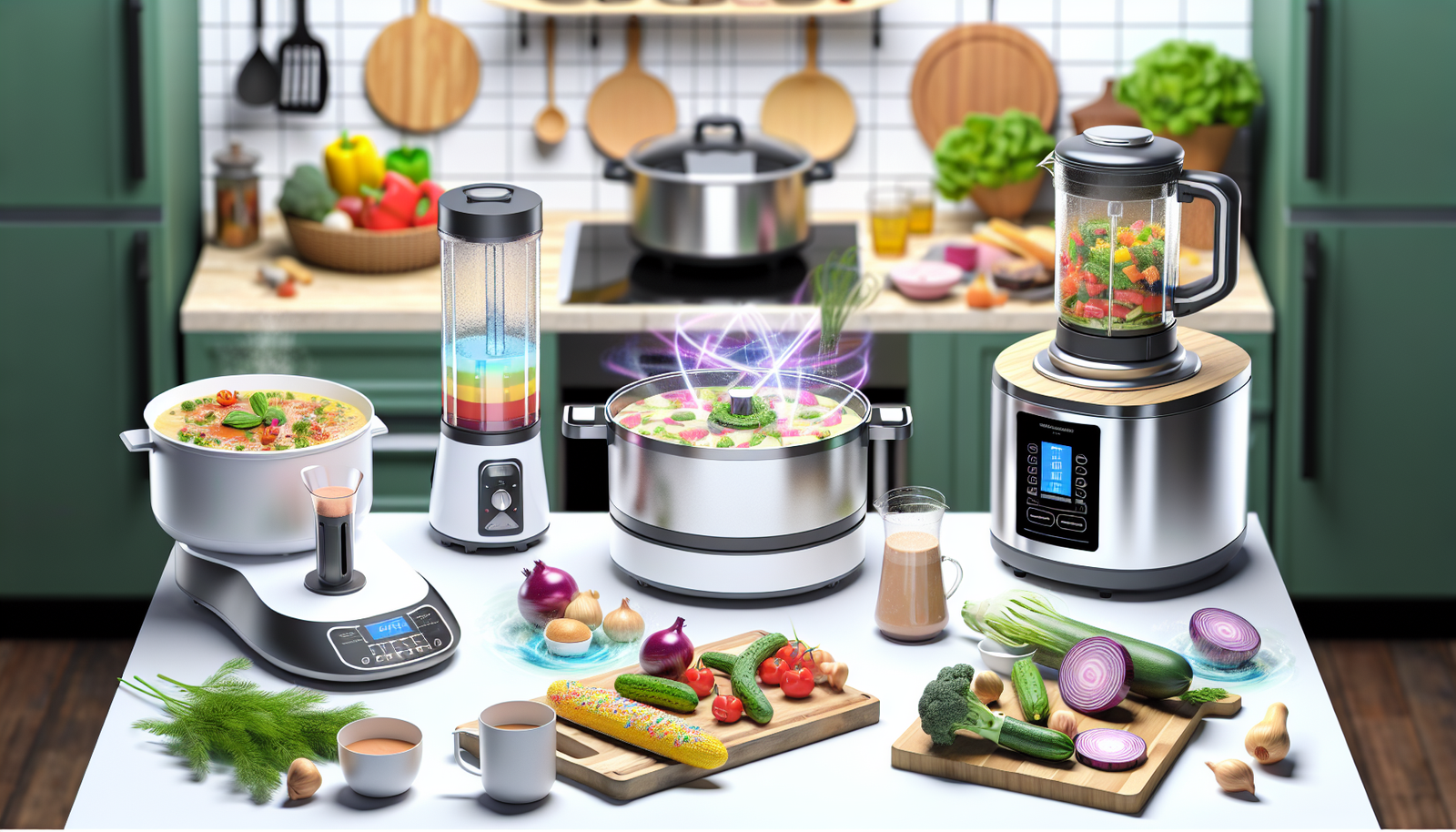
In today’s culinary landscape, kitchen gadgets play a vital role in enhancing the cooking experience.Transform Your Cooking with Kitchen Gadgets This article explores essential tools that not only simplify food preparation but also elevate the quality of dishes. Discover how the right gadgets can transform your kitchen routine and make cooking more enjoyable and efficient.Transform Your Cooking with Useful Kitchen Gadgets That Actually Work
Transform Your Cooking with Kitchen Gadgets
Kitchen gadgets are more than novelties; they translate technique into repeatable results and make complex tasks approachable. At their best, gadgets reduce decision friction and physical effort so cooks can focus on flavor and timing. A well-designed gadget speeds a task without forcing you to change technique, whether that means producing uniform dice for even cooking,
Broad categories of useful tools reveal their roles:
- Cutting and prep tools: peelers, graters, and bench scrapers shape, portion, and transfer ingredients while protecting hands and surfaces.
- Measurement and timing: digital scales, thermometers, and timers give objective feedback so recipes convert reliably from one cook to another.
- Finishing and service: zesters, microplanes, oil sprayers and fine sieves add texture and balance at the last moment.
- Specialty helpers: pastry wheels, piping bags, and mandrel-style tools enable precise technique for specific cuisines or baking tasks.Transform Your Cooking with Useful Kitchen Gadgets That Actually WorkTransform Your Cooking with Kitchen Gadgets

In everyday cooking, a sharp peeler or accurate scale reduces waste and speeds prep; in specialized work — pastry, charcuterie, or sous-vide — a precise thermometer and fine tools make the difference between “good” and professional-level results. Equally important is how quality affects longevity and safety: thin, cheaply made blades dull quickly; poorly balanced handles fatigue wrists;
Choosing effective gadgets means prioritizing ergonomics, materials (stainless metals, food-grade silicone), easy disassembly for cleaning, replaceable parts, and proven warranties. Multipurpose designs can be brilliant, but avoid single-use clutter unless the tool truly transforms a task. The right essentials reduce repetition, preserve ingredients, and free creative energy — a foundation for the more specialized gadgets that follow.
Must-Have Gadgets for Efficient Food Preparation
Food processor. A workhorse for chopping, shredding, kneading and pureeing, a good food processor replaces multiple tools and slashes prep time. Look for a wide feed tube, multiple blade options (S‑blade, reversible shredder/slicer) and a sturdy motor (700W+ for heavy tasks). In practice a pro kitchen uses it to make pâte brisée in 30–45 seconds, blitz roasted vegetables for fillings in a minute, or grate pounds of cheese in under two—tasks that would otherwise take much longer by hand..”Transform Your Cooking with Kitchen Gadgets
Mandolin. For precision slicing, few tools beat a mandolin. Adjustable thickness, julienne and waffle blades produce uniform cuts that cook evenly and plate beautifully. The real efficiency gain is consistency—uniform slices mean predictable cook times and less waste. Safety is paramount: always use the hand guard or a cut-resistant glove and practice steady, even strokes. Chef Ana, a pastry and vegetable specialist, notes, *“A mandolin lets me batch-prep garnishes and gratins with restaurant-level uniformity. Our gratin cooks in half the time because every slice is identical.”*Transform Your Cooking with Kitchen Gadgets
Immersion blender. Immersion blenders finish soups, emulsify sauces and make mayonnaise without transferring hot liquids to a countertop blender—fewer dishes, less heat loss, faster turnaround. Choose a model with a stainless shaft, variable speeds and an anti‑splash bell. Use the tip-to-surface motion for smooth purees and a low-speed start for emulsions. Chef Lila recalls, *“During service, blending a velouté at the pass saves minutes and keeps the line moving—no spills, no cooling, just a silky finish.”*
Small but critical maintenance and safety habits—sharpening blades, avoiding overloads, and proper cleaning—maximize these gadgets’ lifespan and keep your mise en place running efficiently.
Innovative Gadgets That Elevate Cooking
Smart, precision-driven gadgets have shifted cooking from instinct to reliably repeatable craft. At the center are **smart kitchen scales**, which use high-resolution load-cell sensors to measure mass to 0.1 g increments and pair via Bluetooth to recipe apps that scale portions, track macros, and time ingredient additions. Beyond simple weighing, advanced models offer *recipe sequencing*—prompting you when to add ingredients and adjusting quantities on the fly—so complex emulsions, tempering chocolate, or precise dough hydration become manageable for home cooks seeking consistent results.Transform Your Cooking with Kitchen Gadgets
Multi-cookers have evolved from one-trick pots into modular kitchens in a single appliance. Modern units combine pressure, convection, steam, and even air-fry functions governed by microprocessors using PID-style algorithms or adaptive “fuzzy logic” to maintain exact temperatures and pressure profiles. That means braises that break down collagen at controlled rates, or rice and grains cooked with laboratory-like consistency. Searing and Maillard development are achieved by pre-programmed high-heat cycles or integrated searing plates, producing finishes once only possible in restaurants.
Sous-vide systems—immersion circulators and counter-top baths—rely on precise thermostatic control and water circulation to cook proteins and vegetables evenly to a target internal temperature. Paired with vacuum sealers to remove oxygen, sous-vide preserves juices and dissolves connective tissue at low temperatures over hours. A 55°C steak held for an hour yields a uniform medium-rare edge-to-edge; a subsequent high-heat sear produces the Maillard crust without overcooking the interior—techniques now routine in home kitchens thanks to accessible gear.
These gadgets are popular because they democratize professional methods: sensor-driven precision, app-supported recipe libraries, and communities sharing vetted profiles. Expect continued integration—cloud recipes, automated calibration, and device ecosystems—making restaurant-quality textures and repeatable outcomes increasingly achievable at home.Transform Your Cooking with Kitchen Gadgets
Space-Saving Gadgets for Small Kitchens
Space is the most precious countertop in a small kitchen, and well-designed gadgets can free up room without sacrificing performance. Collapsible tools—silicone colanders, mixing bowls and measuring cups that collapse to a flat disk—use accordion-style ribs and a rigid rim to preserve capacity and stability when expanded; choose ones with reinforced rims and heat-resistant silicone so they won’t warp near a hot pot or in the dishwasher. Telescoping utensils and fold-flat whisks keep drawer profiles low while offering full-length reach when in use; look for locking mechanisms that feel positive and durable rather than flimsy.
Multi-functional gadgets earn their place when each function is high quality. Examples that work: a good immersion blender with detachable shaft and storage cup, a mandoline that nests inside its container for slices, and nesting cookware sets with removable or folding handles that let you stack pots and pans vertically without scratching. Prefer modular systems where lids, inserts and handles are interchangeable — that reduces total pieces while increasing flexibility.
Smart storage solutions reclaim dead space:
- Vertical dividers for lids, cutting boards and baking sheets keep items accessible and ventilated.
- Magnetic knife strips and hanging rails move tools off counters but keep them at hand.
- Under-shelf baskets and shelf risers double usable cabinet space; choose wire or solid models that support expected weight.
- Stackable canisters and clear, uniform jars reduce clutter and make inventory visible.Transform Your Cooking with Kitchen Gadgets
How to choose efficiency without losing function: prioritize build materials (stainless steel and high-temp silicone over thin plastic), check real expanded dimensions and weight capacity, test lock mechanisms and ergonomics if possible, and confirm cleaning and replacement-part policies. Finally, keep frequently used tools readily reachable; the best space-savers are ones you actually use every day. This practical approach keeps small kitchens tidy and prepares you to invest wisely in long-lasting gear.
Choosing Quality Gadgets and Avoiding the Gimmicks
Buying the right gadget is as much about skepticism as it is about enthusiasm. Manufacturers use shiny product shots, staged “before and after” scenarios, celebrity endorsements, and urgency (“limited stock”) to create desire, but these don’t prove usefulness. Common tactics to watch for: inflated claims of “revolutionary” performance without measurable benchmarks; vague language like “professional-grade” with no specs; bundled “free” accessories that mask a high base price; and influencer posts that don’t disclose paid relationships. Fake or incentivized reviews also skew ratings—look for repeating phrases, many 5-star one-liners, or clusters of new accounts praising a product.
Focus on objective, verifiable features that predict real-world performance. Materials and construction matter: food-grade stainless steel, reinforced joints, and heat-resistant silicone outlast cheap molded plastics. For cutting tools, look for blade hardness and edge-retention data or reputable lab tests; for mixers and powered gadgets, check motor wattage, duty cycle, and serviceability (can you replace a brush or belt?). Ergonomics are crucial—weight, balance, handle shape and tactile grip determine whether a tool is a pleasure to use. Also verify maintenance needs: are parts dishwasher-safe, easy to clean, and are replacement parts available?Transform Your Cooking with Useful Kitchen Gadgets That Actually Work
When reading reviews, prioritize long-form, dated reports from verified buyers that describe months of use, not just initial impressions. Seek video reviews showing the gadget in regular kitchen contexts and independent testing sites or consumer magazines. Compare multiple retailers’ reviews to spot consistent praise or recurring complaints. Check seller responsiveness to negative feedback—good brands stand behind their products.
Checklist:
– Look for specific specs and materials, not marketing buzzwords.
– Prefer repairable designs and available replacement parts.
– Demand verifiable, long-term user reports and independent tests.
– Avoid single-purpose novelty tools; buy for frequency and durability.
– Check warranty, return policy, and seller reputation before committing.
Conclusions
In conclusion, investing in useful kitchen gadgets can significantly improve your cooking efficiency and skill. By understanding the essentials of effective tools and avoiding gimmicks, you can create a well-equipped kitchen that inspires culinary creativity. Embrace innovative gadgets and watch as they transform your cooking into an enjoyable experience.Transform Your Cooking with Useful Kitchen Gadgets That Actually Work