

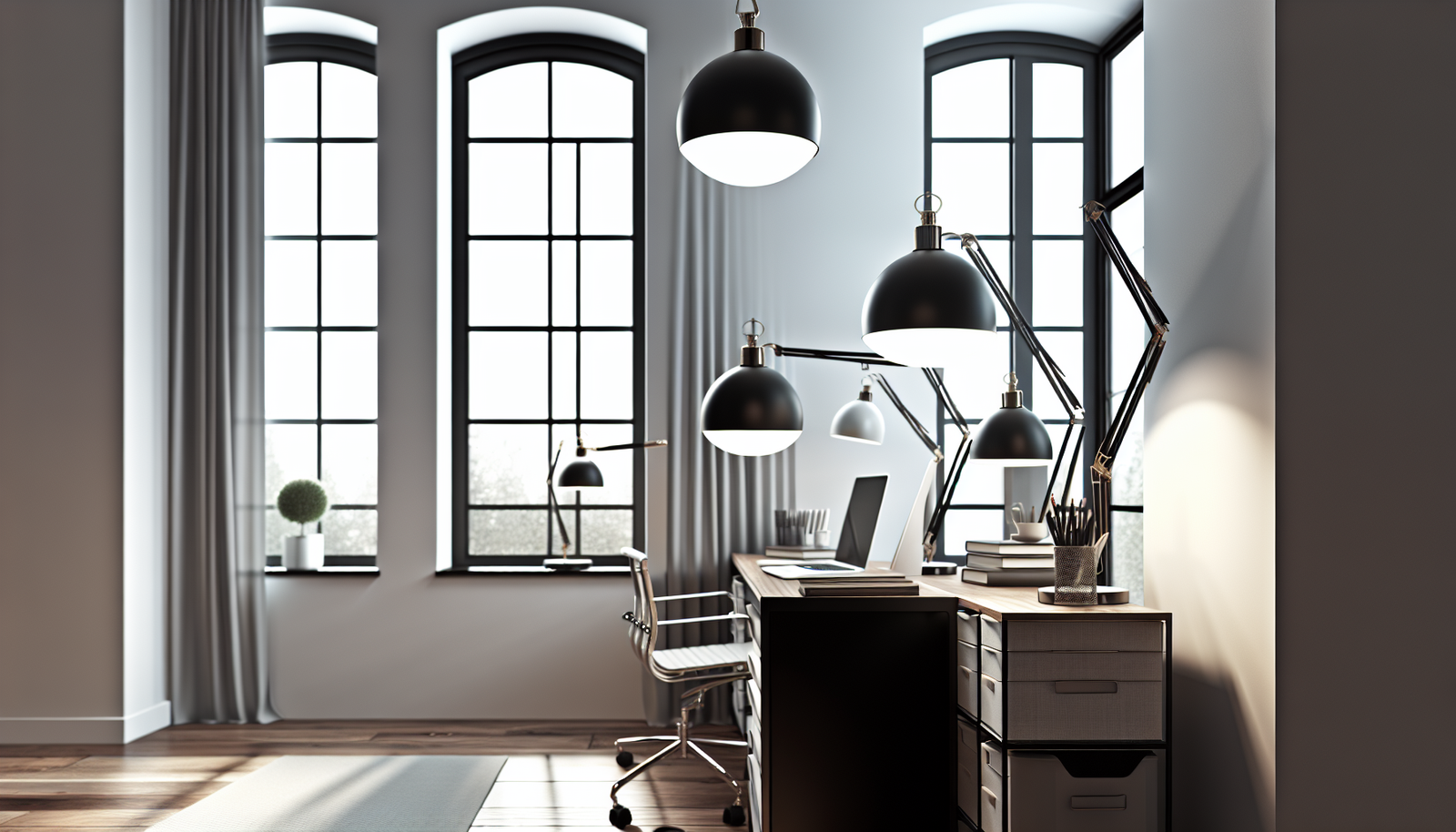
A well-lit home office can significantly enhance productivity and well-being. This article explores the best lighting options, considering the balance between natural light and artificial sources, to create an inviting and effective workspace tailored to individual needs.
The Best Lighting for Your Home Office
Lighting in a home office is far more than a convenience; it is a physiological and cognitive determinant of how you work. Proper lighting directly influences alertness, reaction time, error rates and sustained concentration by aligning visual conditions with the brain’s needs. At the physical level, insufficient or poorly distributed light increases eye strain, squinting and awkward posture; over time this can cause headaches, .
Three complementary layers of lighting form the backbone of an effective workspace: ambient, task and accent. Use them in combination rather than relying on a single source.
– Ambient lighting provides even, glare-controlled illumination for safe movement and low-contrast tasks. Aim for uniformity (luminaire spacing and diffusers) and target approximate average illuminance of 300–500 lux for general office tasks, with a uniformity ratio ideally under 3:1 to avoid distracting bright/dark patches.
– Task lighting supplies concentrated illumination where detail matters — on the keyboard, desk surface or paper. Choose adjustable-arm desk lamps with a focused beam and local dimming; recommended task-
Key technical aspects to prioritize include color temperature and color rendering (CCT 3500–5000K for alert work; CRI ≥90 for accurate color), low flicker drivers, dimmability and shielding to control direct glare and reflections. Integrated controls and tunable white systems let you tailor intensity and spectrum across the day, preserving health and maximizing performance.The Best Lighting for Your Home Office
Natural Light: Harnessing Daylight
Bringing abundant daylight into a home office does more than brighten the room — it changes how the space supports long hours of focused work. *Natural light offers measurable benefits*: reduced energy use, improved alertness, better mood, and softer, more comfortable illumination that reduces visual fatigue. To make the most of daylight, think strategically about where and how light enters and how surfaces and layout distribute it.
Place primary glazing where it captures the most useful light for your schedule. North-facing windows provide steady, diffuse illumination ideal for consistent tasks; east-facing windows give bright morning light that wakes the body; south-facing glazing supplies high daylight levels but benefits from shading (overhangs, awnings or light shelves) to avoid midday glare; west-facing exposure can create harsh late-afternoon sun that needs control. Skylights or tubular daylighting devices can bring overhead light into deep-plan rooms where side windows aren’t sufficient.The Best Lighting for Your Home Office
Use reflective and diffusing treatments to push daylight deeper into the room. High-reflectance ceilings and light-colored walls act as large, passive light sources. Light shelves—horizontal surfaces that reflect incoming sun onto the ceiling—extend daylight penetration. Strategically placed mirrors or glossy, pale furniture surfaces can redirect light without creating glare. For windows that face strong sun, choose translucent shades, diffusing films, or fritted glass to soften direct beams while preserving brightness.
Arrange the desk and monitor perpendicular to windows to minimize screen glare; if direct sun is unavoidable, install adjustable blinds or electrochromic glass for quick control. Combine daylight with simple automation—daylight-harvesting sensors that dim electric lighting when sufficient daylight is present—to lock in energy savings. Thoughtful window placement, reflective surfaces, and glare management turn daylight from a variable element into a reliable, healthful asset for your home office.
Choosing the Right Artificial Lighting
Artificial lighting in a home office needs to do more than simply illuminate — it must support focus, accurate color perception, and comfortable visual contrast without causing glare or fatigue. Different technologies offer distinct trade-offs: *LEDs* are the most versatile—highly efficient, long-lived, low-heat, and available in tunable color temperatures and high CRI versions. *Fluorescent* fixtures (including compact fluorescents) can be economical for larger fixtures but often exhibit limited dimming or flicker and contain mercury. *Incandescent* bulbs render color warmly and smoothly but are inefficient and increasingly rare.The Best Lighting for Your Home Office
Key technical factors to prioritize:The Best Lighting for Your Home Office
– Color temperature: measured in kelvins. For most daytime focused work choose 3500–5000K (neutral to cool white) to support alertness and accurate color; keep warmer tones (2700–3000K) for evening use to avoid circadian disruption. Consider tunable-white fixtures if you work across varied hours.
– Brightness and illuminance: use lumens and lux targets rather than wattage. Aim for ambient room light ss.
Practical fixture selection and placement tips:
– Use directed, adjustable task lamps positioned 18–30 inches from work surface and angled to avoid screen glare.
– For overhead, choose diffused panels, recessed LEDs, or pendants with wide beam angles to minimize harsh shadows.
– Prefer fixtures with shields or diffusers to reduce contrast and reflections on glossy screens.
– For energy and flexibility, favor dimmable, high-CRI LEDs with tunable color and smart controls so you can adapt intensity and tone throughout the day, integrating them smoothly into the layered lighting scheme that follows.
Creating Layers of Light
Layered lighting is about combining multiple light sources so the room supports different activities without forcing a single, harsh light. Think of it as three cooperating roles: *ambient* for general illumination, *task* for focused work, and *accent* for depth and visual comfort. When arranged thoughtfully, these layers reduce eye strain, eliminate deep shadows, and make transitions between tasks smoother.The Best Lighting for Your Home Office
Start by establishing a soft, even ambient layer that fills the room without flattening it. This is the “base” light that prevents high contrast between bright task zones and dark surroundings. Add a dedicated task layer that you can aim and control: adjustable desk lamps or articulated wall-mounted fixtures let you direct light precisely to your keyboard, not into your eyes or the monitor. Position task lights to the side opposite your dominant hand to avoid casting shadows when writing; for dual-monitor or wide desks, consider two smaller task lights rather than one central lamp.
Use accent lighting to break up planes and reduce contrast—shelf strips, under-cabinet LEDs, or a narrow beam to wash a wall. Accent lighting is especially useful behind or beside your monitor to create bias lighting, which preserves perceived contrast and reduces eye fatigue during long screen sessions. Place accent sources so they add depth but are dimmer than task light.The Best Lighting for Your Home Office
Practical arrangements:
– Small corner desk: overhead ambient + adjustable swing-arm task lamp clamped to desk + LED strip under shelf for background depth.
– Large private office: recessed ambient + directional track lights for zones + articulated desk lamp and a floor lamp behind seating for video calls.
– L-shaped setup: ambient on ceiling + two task lights for each work surface + accent lighting highlighting storage or wall art.
Control each layer independently so you can tailor light distribution to the task, the time of day, and the visual backdrop you want while working.The Best Lighting for Your Home Office
Tips for Maintaining Proper Lighting
Keep your workspace adaptable by tuning light levels and color to the activity and time of day. As a practical rule, aim for roughly 300–500 lux on your immediate task surface for reading, paperwork, or detailed work, and lower ambient levels (about 100–300 lux) when the task is primarily screen-based. Use a handheld light meter app or a simple lux meter to measure and set these targets.
Control glare and reflections by arranging light sources deliberately. Position a task lamp slightly behind and to the side of the dominant hand so it illuminates the work without casting a distracting shadow. Keep overhead fixtures out of the direct line between window and monitor; angle diffusers or install indirect fixtures that bounce light off ceilings to reduce harsh specular reflections. For monitors, reduce surface glare with an anti‑glare hood or matte screen and by adjusting monitor tilt and height so ceiling fixtures don’t mirror on the screen.
Minimize shadows by combining a focused task lamp with a softer fill light: a low-output floor lamp or wall washer eliminates deep contrast without raising overall brightness. Use adjustable-arm lamps and movable fixtures so you can change beam direction for different tasks.
Make dimmers and smart lighting your control center. Install dimmers on ambient and task circuits to fine‑tune brightness throughout the day. Use tunable white (CCT) bulbs or smart fixtures to shift from cooler (≈4000–5000K) in the morning for alertness to warmer (≈2700–3000K) in the afternoon/evening to reduce circadian disruption. Program scenes and schedules—“focus,” “video call,” “end of day”—and combine with occupancy or daylight sensors so lighting responds automatically. Choose quality LED drivers and bulbs with low flicker and CRI ≥90 to preserve color fidelity and minimize eye fatigue.
Finally, periodically reassess: check light placement after furniture moves, clean fixtures and shades, and recalibrate brightness if you change monitors or switch tasks—small adjustments keep comfort and productivity consistent.
Conclusions
In conclusion, the right lighting can transform a home office into a productive and enjoyable space. By understanding the importance of both natural and artificial light and implementing strategic layering, individuals can significantly enhance their work experience and overall satisfaction.The Best Lighting for Your Home Office