

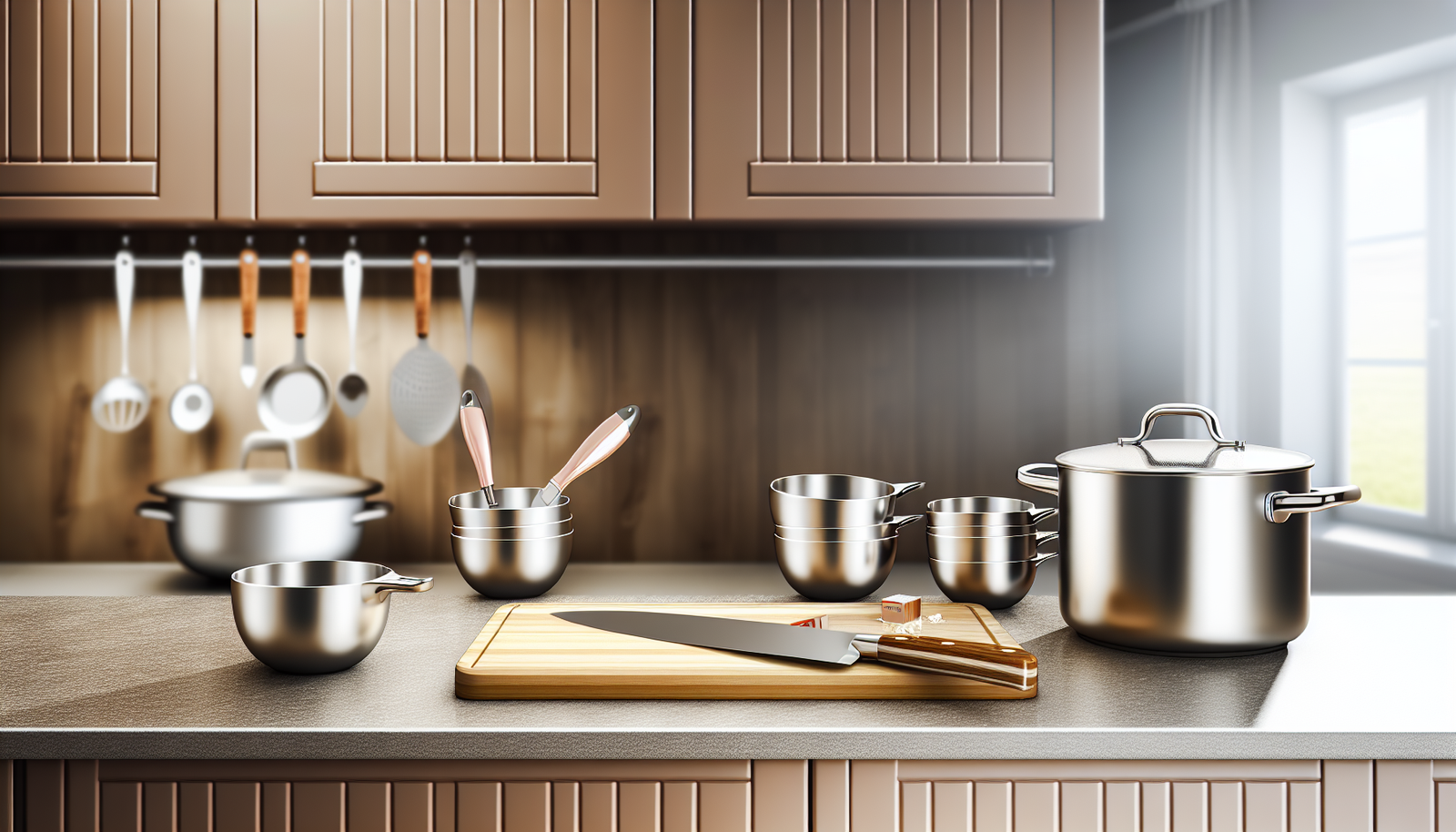
Navigating the world of cooking can be daunting for beginners, but having the right kitchen tools can simplify the experience significantly. This article explores essential kitchen tools that every novice cook should own to enhance their cooking skills and efficiency.Essential Kitchen Tools for Beginners
Essential Kitchen Tools for Beginners
A well-chosen set of knives becomes the most relied-on cluster of tools in a beginner’s kitchen. Focus on three essentials: the chef’s knife, the paring knife, and the serrated knife. The chef’s knife (commonly 8 inches, though 6–10 inches are available) handles the lion’s share of tasks — chopping vegetables, slicing proteins, mincing herbs — because of its curved belly that supports a rocking motion. The paring knife (about 3–4 inches) is for precision work: .Essential Kitchen Tools for Beginners
Maintenance and care are what keep knives performing. Hone regularly with a steel or ceramic rod to realign the edge — ideally before or after each use — and sharpen with a whetstone, guided system, or professional service when the blade no longer slices cleanly (many home cooks need this every 6–12 months). Always handwash and dry immediately, and store so edges aren’t knocked against other metal (magnetic strips, blade guards, or dedicated slots). Avoid dishwashers and hard cutting surfaces that blunt edges quickly.
Practical selection tips:
– Try the knife in hand for balance and comfort; a balanced feel is more important than absolute weight.
– Prefer full-tang construction and secure riveted or molded handles for durability.
– Choose a steel that balances edge retention with ease of sharpening (stainless high-carbon alloys are beginner-friendly).Essential Kitchen Tools for Beginners
– Start with one excellent chef’s knife, one paring knife, and one serrated rather than a large cheap set. Quality over quantity saves money and frustration.
Mastering the Basics: Cutting Boards and Utensils
Cutting boards and basic utensils are the unsung infrastructure that turns good knives and cookware into efficient cooking. Choose cutting boards by material and use: end-grain hardwood (maple, walnut) is gentle on blades and “self-heals” small cuts but needs regular food-grade oiling and is not dishwasher-safe; edge-grain hardwood is more affordable but shows wear sooner; bamboo is harder and more sustainable but can be brittle and may dull blades faster; plastic/polypropylene boards are lightweight, inexpensive, and safe in the dishwasher—replace when deep grooves appear; composite boards (fiberglass/wood fiber) .Essential Kitchen Tools for Beginners
For utensils, prioritize functionality, heat-resistance, and cookware compatibility. Essentials and buying tips:
– Spatulas/turners: one thin, metal-edged turner for grilling/searing and one flexible silicone spatula for folding and scraping; choose slotted vs. solid depending on draining needs.
– Tongs: 9–12″ for stove use, 12–16″ for grill; scalloped tips provide grip; locking mechanism and a firm fulcrum matter.
– Whisks: balloon whisk (8″–10″) for aeration, French/flat for sauces; opt for stainless cores or silicone-coated wires if using nonstick pans.
– Spoons, ladles, and skimmers: one solid spoon, one slotted spoon, and a small ladle cover most tasks.
Look for single-piece or well-riveted stainless handles for durability and hygiene, and choose silicone/nylon heads for nonstick surfaces. Store utensils upright and keep boards ventilated to dry—proper selection and care make prep faster, safer, and more precise.
Cookware Essentials: Pots and Pans
Pots and pans determine what you can cook and how well you can control temperature. Familiarize yourself with a handful of core pieces:
– Saucepan (1–3 quarts): for sauces, grains, boiling eggs and small batches of soup.
– Skillet/frying pan (8–12 inches): day-to-day sautéing, frying and pan-roasting. An 8-inch suits single servings; a 10–12 inch is versatile for family meals.
– Sauté pan (with straight sides, 3–5 quarts): better for reducing liquids and cooking larger vegetable or protein batches because it holds sauces.
– Stockpot (6–8+ quarts): for pasta, large soups and stocks.
– Dutch oven (4–7 quarts, cast iron or enameled): excellent for braising, stews and recipes that move from stovetop to oven.Essential Kitchen Tools for Beginners

Material choice shapes performance. Non-stick pans excel for eggs, pancakes and low-fat cooking—use low-to-medium heat and avoid overheating to preserve the coating. They’re forgiving for beginners but less durable for high-heat techniques. Stainless steel (often clad with aluminum or copper cores) tolerates high heat, browns well and deglazes to form pan sauces—ideal when you want flavor from fond. Cast iron and enameled cast iron retain heat for even braises and oven work; copper offers fastest, most precise heat control but requires upkeep.
Choosing sizes: match pan diameter and depth to number of servings and cooking method. A shallow wide pan increases evaporation for reductions; a deeper pot prevents boil-overs for liquids. For everyday cooking, a 10–12-inch skillet, a 3-quart saucepan and a 6-quart stockpot cover most needs.
Maintenance tips:
– Never overheat empty non-stick; wash gently and air-dry.
– Season and dry cast iron promptly; re-season when food sticks.
– Avoid abrasive pads on stainless; use a paste of baking soda for stubborn spots.
– Don’t expose enameled surfaces to thermal shock or metal utensils that chip edges.
Regular care extends performance and keeps cookware safe and reliable.
Baking Basics: Tools for Sweet Success
Precision in baking starts with the right tools. Measuring cups and spoons are basic, but understanding their roles prevents common mistakes: use liquid measuring cups with a spout for milk and oil and dry-measure cups for flour and sugar. For true consistency, invest in a digital kitchen scale—weights in grams eliminate the variability of scooping and are the standard in professional recipes. Learn to tare the bowl and weigh ingredients directly; it will transform results.
Mixing bowls are more than containers. Choose a set of three sizes (small, medium, large) made from different materials for specific tasks: glass bowls retain heat for melting butter and allow microwaving, stainless steel is lightweight and ideal for whipping, and ceramic can double as servingware. Look for bowls with wide rims for easy whisking, spouted edges for pouring batters, and non-slip bases. Nesting sets save space and make storage straightforward.
Baking sheets and pans deserve attention: a half-sheet (rimmed) pan is the workhorse for cookies and roasting, while rimless or shallow-sheet pans are better for even browning. Opt for heavy-gauge aluminized steel for durability and consistent heat; avoid flimsy pans that warp. Use parchment or silicone mats to prevent sticking and promote even baking; both are preferable to excessive greasing. Cooling racks lift baked goods for airflow and set crisp edges.
Other essential tools: a flexible rubber spatula for folding, a sturdy whisk, offset spatula for frosting, bench scraper for dough, rolling pin, fine-mesh sieve for dusting and sifting, pastry brush, oven thermometer to verify actual oven temperature, and a reliable timer. For beginners, practice the spoon-and-level method for flour if you don’t have a scale, always bring ingredients to room temperature when specified, and weigh or measure precisely. Prepare ingredients (mise en place) before you begin—baking rewards planning and precision.
Smart Storage and Organization Solutions
Smart storage is where a functional kitchen becomes a joyful one: thoughtful placement and organization reduce friction, speed up prep, and protect your tools so they last. Start by creating work zones that mirror how you cook—prep (knives, cutting boards, mixing bowls), stove (spatulas, spoons, pots and pans), and cleanup (dish tools, trash, recycling). Keep frequently used items within your primary reach zone (about elbow to shoulder height and an arm’s length) and reserve high or low cabinets for seasonal or rarely used gear.Essential Kitchen Tools for Beginners
Invest in a few targeted organizers that offer big returns:
- Drawer inserts and modular trays: adjustable compartments prevent utensil jumbles and protect knife edges. Look for bamboo or silicone-lined options that are easy to clean.
- Vertical dividers: store cutting boards, sheet pans, and platters upright to save space and make retrieval effortless.
- Clear, stackable containers: for pantry staples; uniform shapes maximize shelf use and improve visibility. Use airtight lids for flours, grains, and sugar to preserve freshness and deter pests.
- Open shelving, pegboards, and rails: display frequently used cookware or hanging utensils—this frees cabinet space and keeps essentials accessible.
Labeling matters: simple removable labels, a label-maker, or chalkboard paint on jars prevents forgotten ingredients and speeds grocery prep. For spices, consider a drawer spice tray or uniform jars on a tiered shelf so you can scan names quickly. Maintain order with small routines: return tools to their “home” after use, run a quick 10-minute tidy at week’s end, and do a quarterly purge to donate duplicates or broken items. Store produce like onions and potatoes in a cool, ventilated basket—avoid airtight containers that trap moisture. Finally, design for visibility and movement: line shelves with non-slip liners, add under-shelf risers for cans, and, whenever possible, prefer clear over opaque so your kitchen runs smoothly and cooking stays enjoyable.
Conclusions
Equipped with the essential kitchen tools discussed, beginners can embark on their culinary journey with confidence. From versatile knives to reliable cookware, these tools not only simplify cooking tasks but also inspire creativity in the kitchen. Start with these basics and watch your cooking skills flourish.Essential Kitchen Tools for Beginners