

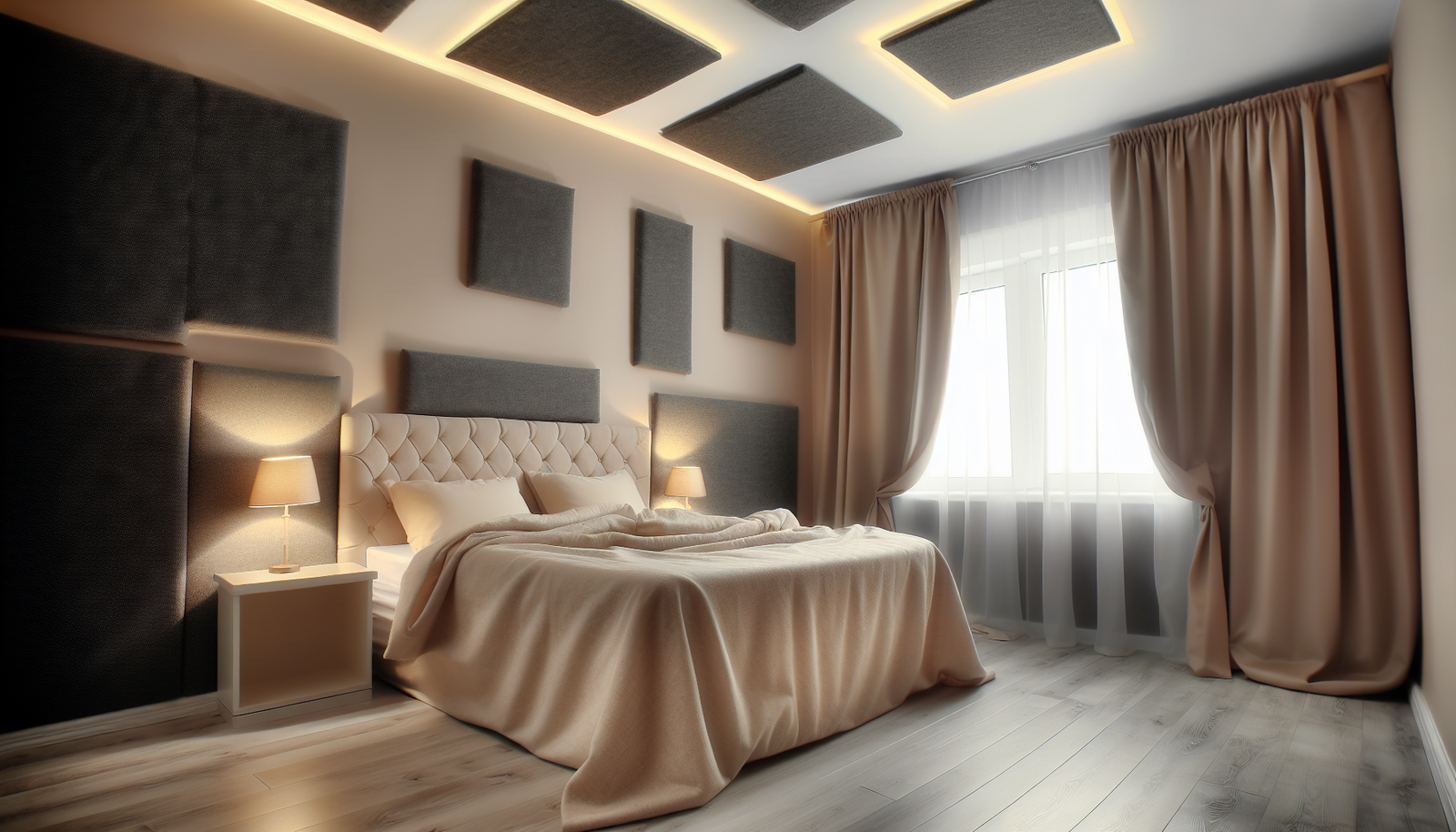
Creating a soundproof bedroom is essential for achieving a peaceful and restful environment. This article explores various DIY soundproofing techniques, materials, and tips that can help minimize noise disruption, enabling you to enjoy tranquility and improved sleep quality. Learn how to effectively soundproof your bedroom walls and experience a more comfortable living space .DIY Soundproofing for Bedroom Walls
Understanding Soundproofing Basics DIY Soundproofing for Bedroom Walls
Sound is a mechanical pressure wave that travels through air and solids; its behaviour depends on *frequency* (pitch) and *wavelength*. High frequencies have short wavelengths and are easily absorbed by porous materials and diffused, while low frequencies (bass) have long wavelengths that penetrate barriers, excite room modes, and transmit through structure. Two broad transmission types matter in walls: *airborne* noise (voices, TV) and *structure-borne* noise (footsteps, vibrations) that travel through framing and flanking paths.
Soundwave interference governs what you hear: waves can add (constructive interference) or cancel (destructive interference), producing standing waves and resonances inside cavities. Resonance amplifies certain frequencies — a critical challenge for bedrooms because low-frequency energy is hardest to control and often requires different approaches than mid/high-frequency issues.DIY Soundproofing for Bedroom Walls
There’s an important distinction between **sound absorption** and **sound blocking**. Absorption converts acoustic energy into heat inside materials (porous absorbers, fibreglass, mineral wool), reducing reverberation and mid/high-frequency reflections. Blocking increases transmission loss — stopping sound from passing through a partition — and relies on mass, stiffness, damping, and decoupling. Key principles that determine blocking performance include:DIY Soundproofing for Bedroom Walls
- Mass law: more mass yields more transmission loss; roughly +6 dB per doubled mass at mid frequencies.
- Damping: energy dissipated in layers reduces resonant transmission.
- Decoupling: separating surfaces (resilient channels, staggered studs) interrupts structure-borne paths.
- Cavity filling: absorptive insulation inside cavities improves overall performance, especially mid/high frequencies.
Two metrics you’ll see are **STC** (Sound Transmission Class) and **NRC** (Noise Reduction Coefficient). STC is a single-number rating from standardized lab tests describing how well a partition reduces airborne sound across speech frequencies — higher is better, but it understates low-bass performance and doesn’t account for flanking paths. NRC is an average absorption coefficient (0–1) across select mid frequencies and reflects room absorption, not barrier transmission. Understanding both helps you choose materials: use absorbers to tame room sound (NRC), and increase mass/decoupling/damping to raise STC where blocking is needed.
Identifying Areas of Sound Leakage
Start by establishing a baseline: pick a quiet period (late night or early morning) and shut off as many internal noise sources as possible—fans, fridge hum, electronics. Then perform a systematic survey from inside the room, moving slowly along each wall and around doors and windows while listening closely for changes in sound level or character. Use a consistent, repeatable test noise outside the room (someone speaking or clapping, a phone ringtone, or a portable speaker playing pink noise) and walk the perimeter inside to note where the test sound is loudest.DIY Soundproofing for Bedroom Walls
Practical techniques to locate leaks:
– Visual inspection: look for visible gaps where trim meets walls, cracks in paint or plaster, uneven window frames, holes for cables, and spaces around outlets and switches.
– Candle, incense, or tissue test: hold a lit candle or incense stick near suspected gaps and watch for flicker, or use a lightweight tissue to see air movement — both indicate airflow paths that also carry sound.
– Flashlight test at night: turn off interior lights and shine a bright flashlight at suspected exterior-facing seams; light showing through reveals openings.
Record findings on a simple floor plan and rate each leak by loudness and ease of repair. Prioritizing the most significant, easiest-to-seal paths will make subsequent material choices and interventions far more effective.DIY Soundproofing for Bedroom Walls
Materials for DIY Soundproofing
When choosing materials after you’ve identified where sound is leaking, pick products that address the specific type and frequency of noise. Here are common DIY-friendly options, their key properties, where they work best, and practical selection tips.
- Acoustic foam panels: lightweight polyurethane or melamine wedges and tiles designed to absorb mid-to-high frequencies. They lower reverberation and reduce echoes inside the room (measured by NRC), but they do very little to stop sound transmission through walls. Use foam to improve room acoustics rather than block outside noise. Cheap and easy to mount, but avoid relying on foam alone for soundproofing.
- Mass-Loaded Vinyl (MLV): a limp, very dense sheet material that adds mass without much thickness. Effective at blocking airborne sound, especially mid-to-high frequencies, and helps with low-frequency if layered properly. It must be installed with continuous coverage and sealed around edges to work. Heavier and pricier per square foot than insulation, but useful for targeted blocking (e.g., interior layer behind drywall).
- Mineral wool (rockwool) insulation: dense fibrous batts placed inside wall cavities. Excellent at absorbing broadband airborne noise and reducing cavity resonance; improves sound transmission loss when combined with mass or decoupling. It’s fire-resistant and moisture-tolerant. Cost-effective for retrofit cavity fills; requires gloves, mask, and a vapor/air barrier or drywall over it.
- Mass-Loaded Vinyl (MLV): a limp, very dense sheet material that adds mass without much thickness. Effective at blocking airborne sound, especially mid-to-high frequencies, and helps with low-frequency if layered properly. It must be installed with continuous coverage and sealed around edges to work. Heavier and pricier per square foot than insulation, but useful for targeted blocking (e.g., interior layer behind drywall).
- Soundproof drywall (damped gypsum boards): multi-layer panels that combine dense gypsum and viscoelastic layers to add mass and internal damping. They increase wall STC more than standard drywall of the same thickness and are relatively straightforward to hang in a renovation. More expensive but often yields the best single-step improvement without structural modification.DIY Soundproofing for Bedroom Walls
Choose by noise type and budget: for echo control use foam; for cavity absorption use mineral wool; for blocking use MLV or soundproof drywall; for best results combine layers (absorb + mass + seal). Consider health/safety, installation difficulty, and the need to seal and finish edges—proper material selection sets up the installation techniques that follow.
Application Techniques for Effective Soundproofing
Start by mapping the wall: locate studs, electrical boxes, and any flanking paths. For mounting **acoustic panels**, place them at first-reflection points (sit on the bed and have a helper move a mirror along the wall to mark spots). Mount heavier panels with Z-clips or French cleats for a secure, flush finish; for rental-friendly installs, use high-strength adhesive Velcro strips or removable panel hangers. Leave a 1–2″ air gap behind panels whenever possible—this significantly improves low-frequency absorption without adding mass.
When adding **resilient channels or isolation clips**, run channels perpendicular to studs at roughly 24″ on-center and fasten channels only to the studs. Crucially, use drywall screws just long enough to penetrate the channel but not reach the stud; if screws bite into studs you’ll short-circuit the decoupling. An alternative is resilient isolation clips (e.g., hat-channel systems) which provide better decoupling at similar installation complexity. Attach the first layer of drywall to the channels, then apply a viscoelastic damping compound between drywall layers before adding the second layer; stagger seams to avoid continuous paths for sound.
Heavy, floor-to-ceiling curtains are low-effort, high-impact. Mount a ceiling track that extends several inches past the wall edges so curtains overlap and seal at the sides. Use double-layer tracks (dense curtain + light decorative layer) to combine absorption and light control. For doors and windows, add overlap and weighted hems to minimize gaps.
Layer strategically — decoupling (channels/clips) first, then damping (compound), then mass (additional drywall), followed by absorption (panels, curtains), with airtight sealing at joints and penetrations. Don’t forget acoustic caulk around perimeters and putty pads on electrical boxes. Address corners with bass traps and always avoid mechanical bridging (long screws, touching frames). Combining these techniques targets both low and high frequencies, giving the best practical results.DIY Soundproofing for Bedroom Walls
Maintaining a Quiet Space
After the hard work of adding soundproofing, the quiet you’ve achieved will be vulnerable to everyday wear, noisy devices, and poor layout choices. Keep the serenity by choosing and maintaining quieter appliances, layering soft furnishings strategically, and arranging the room to work as an acoustic buffer.
Quiet appliances and mechanicals: prioritize low-decibel models — look for published dB ratings and inverter or brushless motors for HVAC, fans, humidifiers, and dehumidifiers. Mount any mechanicals on anti-vibration pads or rubber grommets, and use isolation feet under small appliances. Replace old door closers, hinges, and alarm clocks with soft-close or low-noise alternatives. For heating and cooling, schedule regular maintenance (motor lubrication, secure duct joints, balanced grills) to prevent rattles and tonal noises that often develop over time.
Soft furnishings as long-term absorbers: maintain the effectiveness of rugs, upholstered furniture, and wall fabrics — rotate rugs and fluff/replace compressed padding, wash or refresh textile hangings that trap dust (dust reduces absorption), and re-stuff or replace sagging cushions. Consider dense bookcases filled with irregular items as combined mass and diffusion: periodically reorganize contents to preserve irregular surfaces that scatter sound rather than reflect it.
Strategic layout and behavior: place the bed and primary seating against the quietest wall and use closets or storage as buffer zones against noisy neighbors or hallways. Keep noisy electronics away from the sleep zone; use smart plugs or schedules to power down nonessential devices overnight. Angle dressers and shelving to break direct sound paths and avoid parallel reflective surfaces.DIY Soundproofing for Bedroom Walls
Maintenance and monitoring: create a quarterly checklist: inspect seals and weatherstripping, reapply acoustic sealant where it’s cracked, tighten screws on mounts, test for rattles, and run a simple smartphone dB app and clap test to spot changes. Track changes in a log and treat small fixes early — preventive upkeep preserves your investment and keeps the room reliably peaceful.
Conclusions
In summary, achieving a soundproof bedroom is attainable through understanding the science of sound, identifying problem areas, and using effective materials and techniques. By following the tips provided in this article, you can create a serene sanctuary that promotes better sleep and relaxation. Take action today and enjoy the benefits of a quieter living space.