

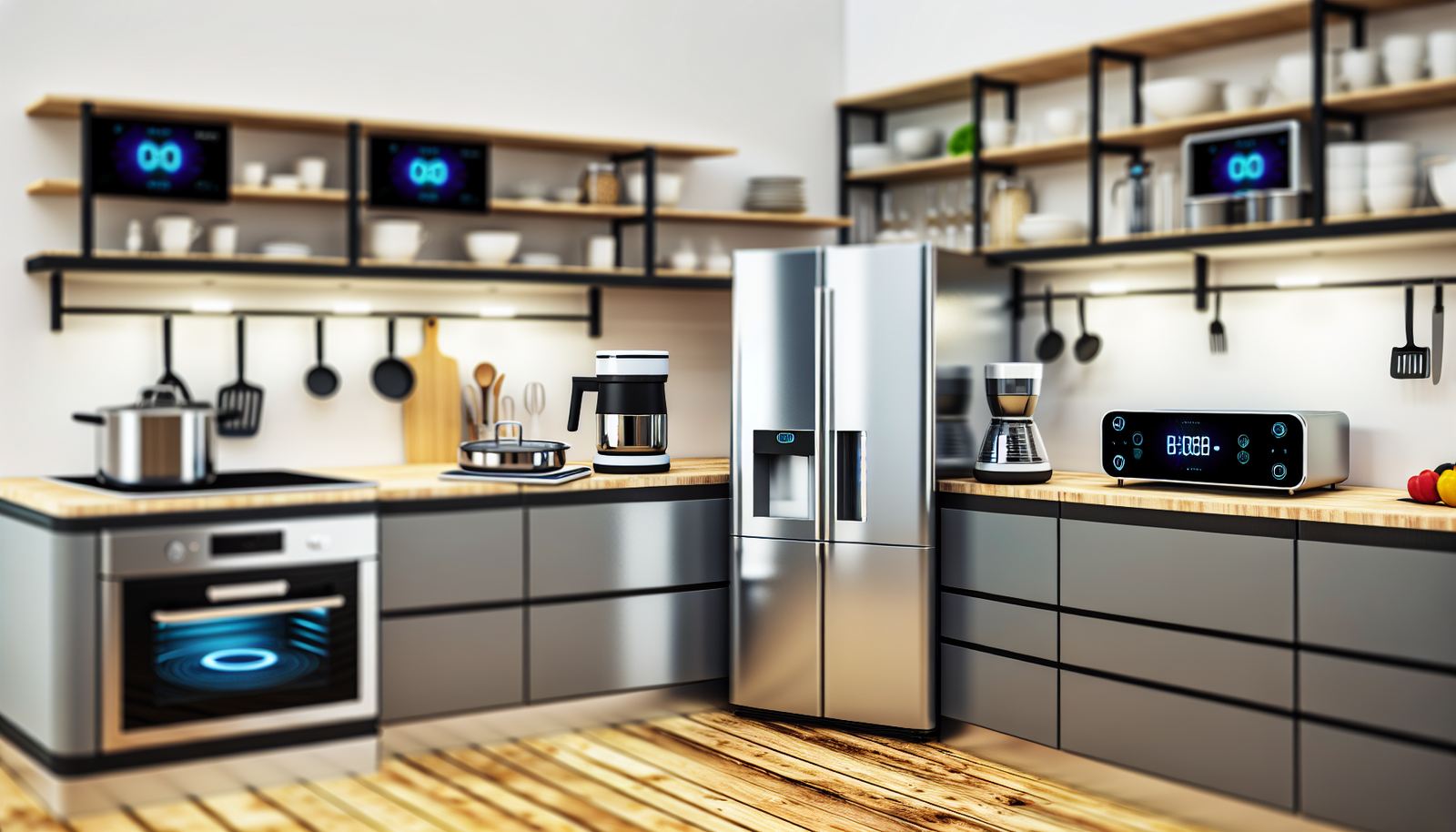
In today’s fast-paced world, smart kitchen gadgets are revolutionizing how we cook and interact with our kitchens. These innovative devices combine technology with convenience, making meal preparation easier, faster, and more enjoyable. This article explores various smart kitchen gadgets designed for modern homes, enhancing both functionality and culinary creativity. Smart Kitchen Gadgets for Modern Homes
Smart Kitchen Gadgets for Modern Homes
Kitchen technology has moved from mechanical convenience to connected intelligence through incremental innovations in sensing, networking and software. Where early electric appliances automated single tasks, the integration of embedded sensors, low-power wireless chips and cloud services ushered in appliances that monitor, adapt and learn. The influence of the Internet of Things is central: networks of sensors and actuators turn kitchens into information-rich environments where ingredient inventories, temperature profiles and usage patterns feed machine-learning models to optimize outcomes and reduce friction for users.
These technological building blocks changed culinary practice more than incremental time-savers. Real-time feedback and guided processes let home cooks execute techniques once reserved for professionals; adaptive control loops maintain precise temperatures for delicate methods, while camera- and sensor-driven guidance enables spontaneous experimentation with unfamiliar ingredients. Remote monitoring and recipe-driven automation free cooks to focus on creativity instead of babysitting, encouraging bolder recipe choices and hybrid workflows that mix manual craft with automated precision.Smart Kitchen Gadgets for Modern Homes

Current trends show a maturing market: consumers increasingly expect connectivity, prioritizing energy efficiency, automation and integration with broader smart-home systems. Industry analyses place smart-feature penetration in appliances and kitchen devices in the low-to-mid tens of percent for installed homes today, with replacement-purchase share notably higher—estimates generally show double-digit annual growth as older stock turns over.Smart Kitchen Gadgets for Modern Homes Surveys indicate roughly one-third of buyers consider connectivity a top-three factor when upgrading appliances, and remote-control, voice control and food-waste reduction consistently rank as preferred features.
Two platform-level shifts accelerate adoption: the rise of standardized interoperability frameworks that simplify pairing and the embedding of edge AI that preserves responsiveness and privacy. As these infrastructures deepen, culinary practice shifts from isolated acts to data-informed, networked routines—unlocking new forms of personalization, predictive assistance and collaborative cooking that reshape how people plan, prepare and enjoy food at home.
Essential Smart Kitchen Gadgets
Smart refrigerators, ovens and multi-cookers form the backbone of a truly connected kitchen, each delivering distinct functions that collectively raise efficiency, safety and culinary consistency. A modern smart refrigerator does far more than keep food cold: integrated cameras and barcode/QR scanning track inventory and expiration dates, while compartmentalized temperature zones and adaptive cooling extend freshness. Firmware-driven diagnostics optimize compressor cycles for energy savings, and built-in recipe engines suggest meals based on what’s inside, sending shopping lists or auto-order requests to preferred grocery services. Remote access lets users check contents and fridge health from a phone, and alerts notify of temperature drops or opened doors to prevent spoilage.
Smart ovens combine precision sensors, multi-point temperature probes and advanced heating profiles to deliver repeatable results. Features like steam injection, convection-air-fry modes and camera monitoring enable pro-level browning and texture control. The real advantage is workflow automation: recipe apps or voice commands can auto-set temperature, preheat windows, monitor doneness via probe telemetry and transition to warming mode when cooking completes. Safety integrations — linking smoke/CO alarms and hood ventilation — can automatically pause or ventilate when abnormal conditions are detected.
Smart multi-cookers bring pressure, slow-cook, sous-vide and sear functions into one networked unit. Onboard sensors adjust pressure or temperature curves in real time for consistent texture, and app-guided “smart programs” step users through complex recipes, shifting modes automatically (sear → pressure → slow cook). Locking lids, altitude compensation and predictive timing reduce user intervention, while cloud-updated recipe libraries expand capabilities over the product lifetime.
These devices integrate through voice assistants, smart displays and emerging standards to form coordinated automations: preheat triggered by a recipe start, fridge-initiated grocery orders, or a multi-cooker starting remotely on the commute home. Together they create a connected ecosystem that emphasizes reliability, time savings and predictable culinary outcomes.Smart Kitchen Gadgets for Modern Homes
How Smart Gadgets Improve Meal Preparation
Smart kitchen gadgets transform meal preparation by moving repetitive, error-prone steps from human hands to precise sensors and automated sequences. Smart scales, automated food processors, and intelligent recipe apps form a tight triad that increases speed, accuracy, and nutritional control.Smart Kitchen Gadgets for Modern Homes
Smart scales do more than weigh: they provide instant tare adjustments, ingredient-by-ingredient logging, and real-time portion calculations. When paired with guided recipes they automatically convert volumes to grams for consistent baking, calculate per-serving nutrition, and help plate exact portions to meet calorie or macro targets. This level of precision reduces over-portioning, avoids ingredient waste, and ensures predictable results—critical for time-sensitive techniques like tempering chocolate or proofing dough.
Automated food processors now include programmable blades, speed profiles, and texture sensors that detect doneness or desired fineness. Rather than constant manual attention, users set a profile (chop, purée, knead) and the unit sequences pulses, rest times, and even temperature control for tasks like nut butter, dough, or emulsions. Such automation shortens prep time, produces uniform textures that improve final dishes, and limits wasted attempts from inconsistent processing.
Recipe apps provide structured, adaptive guidance that complements hardware. Beyond static recipes, modern apps scale ingredients to household size, suggest substitutions for expiring pantry items, and batch-plan meals to reuse components across the week—substantially cutting food waste. They can break complex dishes into timed tasks so you prepare multiple elements in parallel, reducing total active cooking time.
Practical benefits include:
- Time savings from automated sequencing and parallel tasking
- Waste reduction via precise portions and pantry-aware recipe suggestions
- Improved health outcomes through accurate nutrition tracking and portion control
- Consistent culinary results thanks to sensor-driven precision
Together, these tools shift meal prep from guesswork to reproducible, efficient workflows that elevate both everyday cooking and health-conscious eating.Smart Kitchen Gadgets for Modern Homes
Innovative Features of Smart Kitchen Gadgets
Smart kitchen gadgets differentiate themselves through a suite of interactive, networked capabilities that turn appliances into responsive, safety-first partners rather than passive tools. At the core are **voice control capabilities** that go beyond simple on/off commands: natural-language parsing allows multi-step instructions (“preheat oven to 180°C, then set timer for 20 minutes and lower heat to 160°C after 10 minutes”), contextual follow-ups, and hands-free mode during messy prep. Voice systems also tie into user profiles so commands reflect dietary preferences, portion sizes, and accessibility needs.
Mobile app integrations provide the dashboard for deeper control and personalization. Modern apps expose:
– real-time telemetry (temperatures, energy usage, cycle progress),
– remote scheduling and preconditioning,
– synchronized shopping lists and calendar-aware meal planning,
– granular permissioning so household members or guests only access appropriate controls.Smart Kitchen Gadgets for Modern Homes
Real-time monitoring uses an array of sensors (infrared thermometers, humidity, VOC, pressure, liquid-flow) and local analytics to produce actionable alerts rather than noise. Examples include predictive overheat warnings that step in before smoke is produced, gradual leak detection that triggers valve closure, and cross-device orchestration where the hood and stove coordinate fan speed with cooktop power. These systems use edge processing to minimize latency and preserve privacy while still offering cloud-based logging and firmware updates.
User-friendly design is achieved through adaptive interfaces: guided, stepwise cooking modes that pause when a sensor detects elevated humidity, multimodal feedback (audio, visual, haptic) for noisy environments, and accessibility features such as high-contrast displays and voice feedback for visually impaired users. Safety enhancements include automatic hardware lockouts, child-proof modes, geofencing-triggered shutdowns when homeowners leave, and secure OTA patches. Together, these features enable confident remote management of the kitchen without sacrificing responsiveness, safety, or personalization.
The Future of Smart Kitchens
Future smart-kitchen innovation will center on systems that *think* about cooking the way experienced chefs do—anticipating flavor, timing, and nutrition. AI-powered cooking assistants will go beyond recipe playback to become adaptive collaborators: combining computer vision, aroma/spectroscopy sensors and user dietary profiles to judge doneness, suggest seasoning adjustments, and generate novel recipes from what’s on hand. These assistants will learn individual taste maps, predict how textures evolve during cooking, and autonomously tune multi-step processes across connected appliances so complex dishes can be executed with chef-level precision while preserving creative input.
Smart pantry management will evolve from barcode lists into predictive, networked food intelligence. Expect in-cabinet computer vision and shelf sensors that track quantity, biochemical freshness markers and purchasing patterns. Automated meal plans will prioritize items by optimal use-window, dietary goals and cost, while negotiating with grocery and local-supplier APIs to schedule staggered deliveries or trigger micro-restocking. Blockchain-backed provenance and traceability will allow the pantry to flag allergens or sustainability scores, enabling intelligent substitution when necessary.
Sustainability advances will permeate hardware and service layers. Appliances will use dynamic energy profiles tied to home-grid and local renewable forecasts, shifting high-load processes to low-carbon windows. New materials and modular designs will extend appliance lifespans and enable component recycling. Onsite food-waste processors—compact anaerobic digesters, enzymatic composters or upcyclers—will convert scraps into usable biofertilizer or cooking fuels. Water recovery loops and precision cooking techniques will reduce resource intensity while preserving flavor.
These trends will reshape what “cooking” means: a hybrid human-AI craft combining creative intent with automated optimization, lowering friction for healthy, sustainable meals while raising questions about privacy, data ownership and skill retention. Regulatory frameworks and design transparency will be crucial as homes become data-rich food environments and the kitchen becomes a central node in circular food systems.
Conclusions
Smart kitchen gadgets are not just about convenience; they transform the culinary experience and streamline daily tasks. By integrating technology into our kitchens, we embrace a new era of cooking that enhances creativity and efficiency. Investing in these gadgets can elevate meal preparation while aligning with the needs of modern home life.Smart Kitchen Gadgets for Modern Homes
—